Do you drive to work, sports, or family daily? Then the chance is higher than ever that you unknowingly risk a traffic fine. The figures for traffic fines in 2025 show that more fines have been issued than in previous years. Especially for holding a phone, not wearing a seatbelt, and other common traffic violations, fines are more often issued. What exactly has changed? And more importantly: how do you avoid receiving expensive fines?
Why are there more traffic fines?
Figures from the Dutch government show that in 2025, more fines were imposed for most traffic violations. The increase in these traffic fines is mainly due to more intensive enforcement by the police and the use of new technology.
According to the official report, these developments are visible, among others:
• More fines for holding a phone while driving • More fines for cyclists without lights • More checks by officers during stops • Use of focus flashers that monitor the use of electronic devices
The focus flasher detects whether a driver is holding a phone or other electronic devices while the vehicle is moving. Even when a vehicle is stopped at a red light, holding a phone can be considered a violation. This happens not only on the highway but also in built-up areas or at an intersection.
Important to understand: the number of fines is increasing not only because people violate the rules more often, but also because enforcement has become smarter. More checks mean a higher chance of being caught.
Do you want to view the exact figures and fine amounts? Read the full government report via rijksoverheid.nl.
For which offenses are the increases the largest?
The increase in traffic fines for 2025 is particularly visible in several specific categories.
Phone use in traffic
The number of fines for holding a phone while driving has increased significantly. This applies to motorists, as well as cyclists and e-bike riders. This includes texting, calling without hands-free use, or using other electronic devices.
Many people think that a quick check can't hurt. However, this is considered a violation that can cause danger in traffic.
Cycling without lights
Cyclists without working lights also run a greater risk of getting a fine. Especially in built-up areas, this is actively checked. Poor visibility can cause dangerous situations, especially at an intersection or when you fail to yield.
Seatbelt non-compliance
Not wearing a seatbelt is an offense that still occurs frequently. Wearing a seatbelt is mandatory. Due to extra police checks, more fines have been issued for this. A small mistake can therefore lead to a hefty traffic fine.
Other common offenses
Besides phone use and seatbelt non-compliance, speeding fines also remain common. Speeding on the highway or in built-up areas is strictly controlled.
Also, unnecessary stopping on the hard shoulder, failing to yield at an intersection, or causing unnecessary noise with your vehicle can result in a fine.
Even things like wearing both earbuds while cycling can pose a danger if you don't hear important traffic sounds. Listening to music or music players is allowed, but it should never compromise your safety or hearing. If you don't hear a siren due to loud music, it can pose a risk.
What does this mean for you as a driver or cyclist?
The reality is that small habits are more likely to be fined.
Just holding your phone to text
Just setting navigation while stationary
Just cycling without lights
Just making a short trip without a seatbelt
What sometimes went unnoticed before, is now registered more quickly. The combination of technology and active checks by the police and the public prosecutor's office ensures that violations are followed up faster.
A fine may seem like a small amount, but the amounts quickly add up. In addition, there are often administrative costs. In some cases, a serious offense can even have consequences for your driving license.
The difference between safe driving and an expensive mistake often lies in small habits.
How to avoid traffic fines in 2026?
Traffic fines in 2025 show that the chance of being caught has increased. Smarter checks, focus flashers, and more enforcement ensure that small mistakes are registered faster. That's why preparation is more important than ever.
At R2B, we not only look at products but at traffic situations where things go wrong. Most fines do not arise from unwillingness, but from convenience, haste, or routine.
Hands-free use for navigation or listening to music
One of the biggest causes of a traffic fine remains holding a phone while driving or cycling. Briefly adjusting navigation, checking a message, or starting music seems innocent, but is considered a violation of the law.
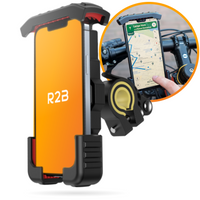
We help you eliminate that risk by offering solutions that make hands-free use self-evident. A stable attachment of your phone ensures that your navigation remains visible without you having to hold your device. This keeps your attention on the road, reduces dangerous situations, and prevents a fine excluding administrative costs.
Visibility prevents risks
Cycling without proper lighting is also a common reason for a fine. But more importantly: poor visibility causes danger, especially in built-up areas or at an intersection where right-of-way must be granted.
That's why we focus on reliable, rechargeable lighting that is easy to use. No loose batteries, no doubt whether the light works, but certainty before you set off. This way you drive visibly and according to the rules.
Make safety a fixed routine
Before departure, check:
• Phone correctly secured in your phone holder • Lights working • Navigation pre-set • Seatbelt fastened • No unnecessary noise or distractions
By following this fixed routine, you prevent a small mistake from turning into an expensive traffic fine.
Frequently asked questions
1. Can you use your phone when stopped at a red light?
Many drivers think that holding a phone is allowed when the vehicle is stopped at a red light. However, according to the law, you are not allowed to hold a mobile electronic device as long as you are participating in traffic, even if you are temporarily stationary. This means that a violation can also be detected at a traffic light. Only hands-free use is permitted. Due to the use of focus flashers, the chance that such moments are recorded is greater.
2. Are focus speed cameras also used on provincial roads and in urban areas?
The reports indicate that focus speed cameras are placed in various locations, but not always exactly where. Many people wonder whether these cameras are only on motorways or also in urban areas and on provincial roads. In practice, they are deployed in varying locations precisely to create unpredictability. This means that you can be checked anywhere. The chance of being caught is therefore not limited to motorways.
3. What happens to the photos taken by focus speed cameras?
Another frequently asked question is what exactly happens to the images taken. The focus speed camera registers a possible infringement, but the assessment is not fully automatic. Images are checked before a fine is imposed. If no infringement is found, the images are not used further. Processing falls under strict privacy rules.